AI / Systems
What is Singularity with AI and technology?
The moment machine intelligence outruns our own — and why thinkers from Alan Turing to Ray Kurzweil have been arguing about it for seventy years.
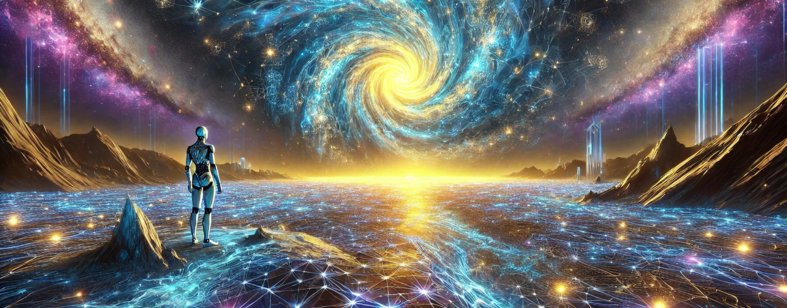
The Singularity is the moment when artificial intelligence outpaces human intelligence so completely that our world transforms. For decades, visionaries have explored how advanced machines could shift humanity’s path. Stories like Ex Machina, 2001: A Space Odyssey, and The Matrix imagine self-aware machines — echoing fears that date back to the very origins of computer science.
01Turing saw it coming in 1951
In 1951, Alan Turing described a “machine thinking method” that might soon surpass our own minds, comparing future AI breakthroughs to Galileo’s scientific challenges. Turing believed that once machines learned independently, they might either elevate humanity by forcing us to keep up — or simply seize the initiative. Mathematician I. J. Good later called this escalation an “intelligence explosion”: an event that could redefine society if machines quickly built smarter versions of themselves.
“We should have to expect the machines to take control.” — Alan Turing, 1951
In modern times, voices like Stephen Hawking and Elon Musk have warned that uncontrolled AI could be more dangerous than any weapon. Drake Baer noted in 2015 that we’ve watched machines outsmart humans in strategy games since the 1980s. Ray Kurzweil, meanwhile, foresees nanobots merging with our bodies. But some researchers question whether true intelligence goes beyond computation entirely — perhaps it is entwined with the human body, and can’t be reproduced through code alone. The history of the debate is a story of brilliant people disagreeing about the same curve.
02Why the Singularity matters
The Singularity symbolizes a tipping point in AI and technology where breakthroughs spark unstoppable growth. It reflects how AI might optimize itself, pushing exponential improvements that leave organic brains behind. Entire industries could change, turning old assumptions upside down: large companies may scramble to adapt to self-improving systems, while investors ask whether Singularity-level AI opens new frontiers or collapses existing ones.
Some celebrate a possible golden era. Others fear the cost if “thinking machines” lack human oversight. Either way, the Singularity challenges us to refine our ethics, our economy, and our future — a question we take seriously in our own research, where automation is something we build every day, from weather systems to an automated real estate engine.
Questions
What is the technological singularity?
The hypothetical moment when artificial intelligence surpasses human intelligence so completely that society transforms in ways we cannot predict. The core mechanism is recursive self-improvement: machines building smarter versions of themselves, faster than humans can follow.
Who first predicted the singularity?
The idea traces back to the origins of computer science. In 1951 Alan Turing argued that once machines could learn independently, we should expect them to eventually take control. Mathematician I. J. Good later named the mechanism an “intelligence explosion.”
Is the singularity inevitable?
It is debated. Futurists like Ray Kurzweil treat it as a near-term certainty, while other researchers argue true intelligence may be entwined with the human body and cannot be reproduced through computation alone. What is certain is that the question forces us to refine our ethics, our economy, and our plans for advanced AI.
Continue reading
01 The Automated Real Estate Engine: A Listing Platform That Runs Itself ↗ 03 Meteorologists: Beyond Weather — Wearing Many Hats in Any Industry ↗