
Science / Space
Is Earth flat, round… or something else?
Forget the memes — let’s measure. Earth’s mass and spin flatten the poles and bulge the equator, and satellites have mapped the result in stunning detail.
In movies, in telescopes, through lenses, and through our own eyes, Earth appears to be a round shape. And it nearly is — but “nearly” is where the interesting science lives.
01What shape is Earth, really?
Earth is a huge, wondrous planet whose gravity pulls everything toward it — oceans, rivers, even the water vapor in the air. Earth’s tilt and constant rotation, working together with that gravity, keep the oceans hugging the planet while the whole system spins. The result looks like a perfect ball from space, but the spin stretches it: the technical name for Earth’s shape is an oblate spheroid.
- Oblate means flattened at the poles — which also means wider at the equator.
- A spheroid is a planet’s close cousin of the sphere: mostly round, but a bit squished or stretched depending on how it formed.
- The numbers: Earth’s equatorial radius is roughly 21 km larger than its pole-to-pole radius, and local gravity varies by up to about 0.1% across the surface.
02The satellite that measured it
This isn’t a guess — it’s a measurement. The European Space Agency’s GOCE satellite gathered enough data to map Earth’s gravity field in unprecedented detail, producing the famous geoid rendering (exaggerated about 7,000× so human eyes can see the lumps):
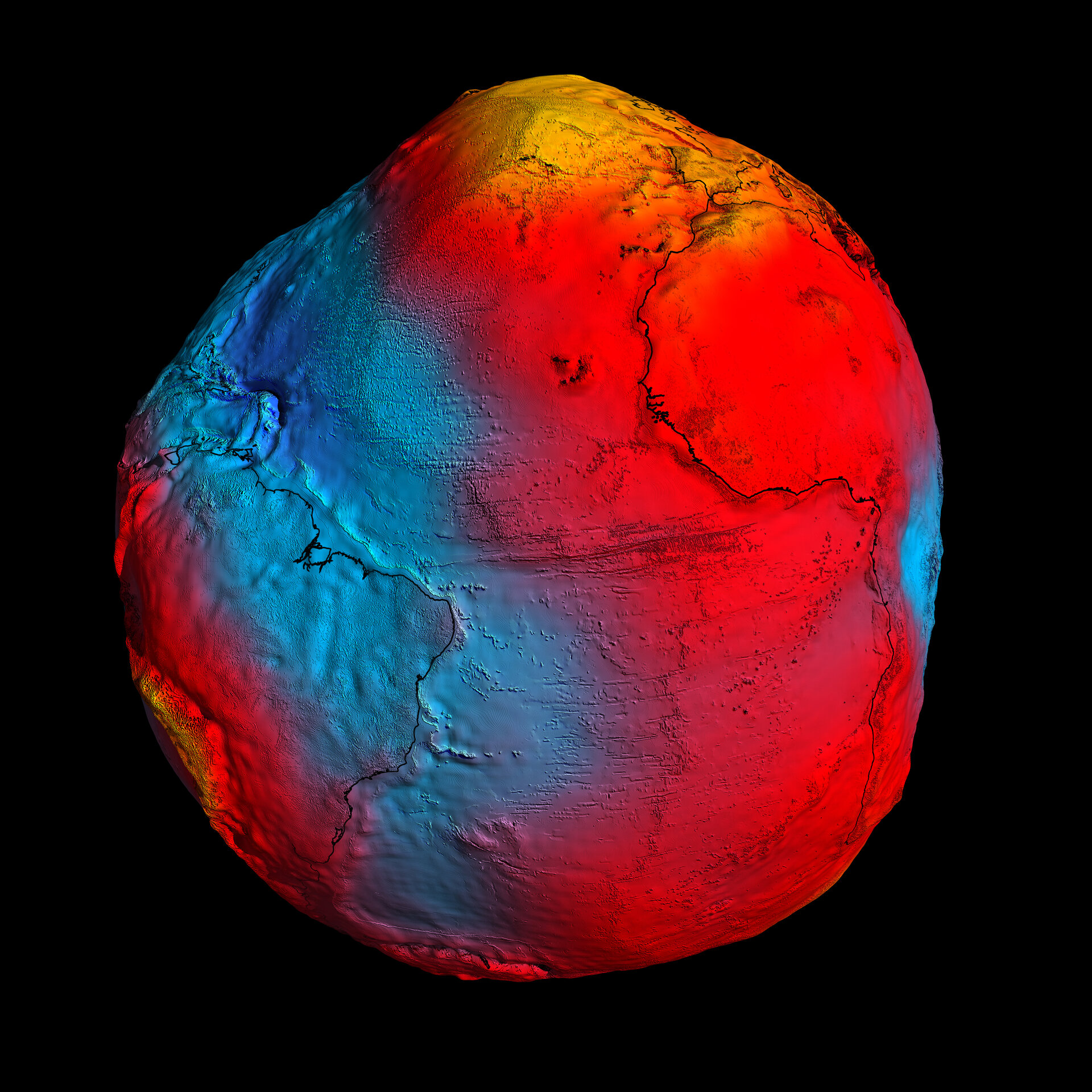
Agencies like NOAA describe the same conclusion from independent measurements: Earth is an irregular, rotation-flattened spheroid — not flat, and not a perfect ball either.
Questions
Is Earth perfectly round?
No. Earth is an oblate spheroid — mostly a sphere, but flattened at the poles and bulging at the equator because of its rotation. The equatorial radius is roughly 21 kilometers larger than the polar radius.
What is an oblate spheroid?
Oblate means flattened at the poles and wider at the equator. A spheroid is a shape that is mostly a sphere but slightly squished or stretched. Put together: a sphere flattened by its own spin — exactly what Earth’s rotation does.
How do we know Earth’s real shape?
Satellite geodesy. ESA’s GOCE satellite mapped Earth’s gravity field in unprecedented detail, producing the geoid — Earth’s true shape as defined by gravity. It confirms the oblate spheroid form and shows local gravity variations of up to about 0.1 percent.
Continue reading
01 The Automated Real Estate Engine: A Listing Platform That Runs Itself ↗ 02 What Is Singularity with AI and Technology? ↗